Myopia in Children: Causes, Symptoms & Latest Treatments
Is Your Child Squinting to See the Whiteboard? It Could Be More Than Just Tired Eyes.
Picture this: your child is sitting front row in class, yet still struggling to read what’s written on the board. Or maybe they hold their phone frustratingly close to their face every single time. These aren’t habits — these could be early signs of myopia, or nearsightedness, a condition silently spreading among children across India and the world.
If you’ve recently stepped into a trusted Eye Hospital in Lucknow, chances are the doctors there have mentioned a sharp rise in childhood myopia cases. At D.K. Eye Care Hospital, we see this every day — young children, some as young as six, walking in with progressively worsening eyesight.
This guide breaks down everything parents need to know: what myopia is, why it’s happening, how to spot it early, and — most importantly — what the latest treatments can do to protect your child’s vision for life.
What Exactly Is Myopia?
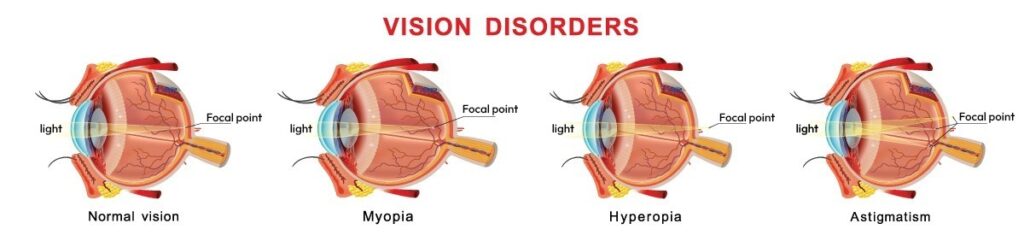
Myopia, commonly known as nearsightedness, is a refractive error where the eye grows slightly too long. This causes light entering the eye to focus in front of the retina instead of directly on it.
The result? Distant objects look blurry. Close objects look fine.
It sounds simple, but the consequences are not. Untreated or fast-progressing myopia in children can lead to:
- High myopia (power above -6.00D)
- Risk of retinal detachment
- Increased chances of glaucoma later in life
- Myopic maculopathy — a potentially irreversible vision condition
The global numbers are alarming. Roughly one in three children and adolescents worldwide is affected by myopia, and this figure is rising sharply, especially in urban populations. India is no exception.
What Causes Myopia in Children?
There is no single cause. Myopia is typically the result of a combination of genetic and environmental factors.
1. Genetics / Family History
If one parent has myopia, your child’s risk doubles. If both parents are myopic, the risk increases by nearly six times. The shape and size of the eye can be inherited.
2. Excessive Near Work
Reading, writing, using smartphones, tablets, or laptops for long periods without breaks keeps the eyes in a constant state of close focus. Over time, this can signal the eye to elongate — the key mechanism behind myopia.
3. Lack of Outdoor Time
This is one of the most evidence-backed risk factors. Children who spend less time outdoors have significantly higher rates of myopia. Natural light plays a key role in regulating healthy eye growth. Research shows that at least 2 hours of outdoor time daily can help reduce myopia risk.
4. Urban Lifestyle
Children in cities tend to spend more time indoors, with more exposure to screens and less access to wide, open spaces. Urban environments are directly linked to higher myopia prevalence.
5. Screen Time and the COVID Effect
Post-COVID studies found that children who studied from home for long periods showed accelerated myopia progression — directly linked to increased near-screen time and reduced outdoor exposure.
Early Warning Signs: What to Watch for in Your Child
Children rarely complain about blurry vision — because they assume everyone sees the world the way they do. That’s why parents must be the first line of detection.
Watch out for these signs:
- Squinting to see distant objects (TV, board, faces across the room)
- Sitting very close to the TV or holding books unusually close
- Frequent eye rubbing, especially when trying to focus on something far
- Headaches after school or screen time
- Losing interest in sports or outdoor activities that require distance vision
- Poor academic performance, particularly difficulty reading the board
- Tilting the head or closing one eye to see better
If your child shows two or more of these signs, it is time for a comprehensive eye examination — not just a school screening.
How Is Myopia Diagnosed?
Diagnosis is simple and painless. An eye doctor will typically conduct:
Test | What It Checks |
Visual Acuity Test | How clearly the child can see at a distance |
Retinoscopy / Refraction | Measures the degree of refractive error |
Cycloplegic Refraction | Uses eye drops to relax the eye muscles for accurate measurement |
Axial Length Measurement | Tracks how fast the eyeball is elongating |
Fundus Examination | Checks for retinal health, especially in high myopia |
Cycloplegic refraction is especially important in children because young eyes can compensate for power errors using muscle accommodation. Without the drops, the actual power may be underestimated.
Latest and Most Effective Treatments for Childhood Myopia
This is where the real progress is happening. Modern myopia management has moved well beyond just prescribing thicker glasses every year. Today’s treatments focus on slowing or stopping progression — not just correcting current vision.
1. Orthokeratology (Ortho-K Lenses)
These are specially designed hard contact lenses worn only at night. They gently reshape the cornea while the child sleeps, providing clear, glasses-free vision during the day. More importantly, they slow axial elongation — the main driver of myopia progression.
Best for: Children aged 8 and above who are active or involved in sports.
2. Low-Dose Atropine Eye Drops (0.01% – 0.05%)
One of the most researched and widely used myopia control treatments globally. Low-dose atropine is applied once daily at bedtime. It has been shown to reduce myopia progression by 30–60% with minimal side effects at low concentrations.
Best for: Children with rapidly progressing myopia, especially when combined with optical interventions.
3. Defocus-Incorporated Spectacle Lenses (DISC / MiSight Lenses)
These are not regular glasses. They use peripheral defocus technology — multiple tiny lenslets built into the lens — to send signals to the eye to slow its growth. Studies show these lenses can cut progression by up to 60% when worn consistently.
Best for: Children who prefer glasses over contact lenses.
4. Multifocal / Dual-Focus Contact Lenses
These soft contact lenses correct vision at the centre while creating a blur signal at the periphery that discourages further eye growth. They are the only FDA-approved myopia treatment (in the US) for children.
5. Repeated Low-Level Red Light (RLRL) Therapy
An exciting emerging option. The child looks into a low-powered red light device for a few minutes a day. Clinical trials have shown it can significantly slow myopia progression and, in some cases, even slightly reduce existing power. It is non-invasive and painless.
Still gaining evidence base in India, but results from Asian studies are promising.
6. Increased Outdoor Time
The simplest and most accessible intervention. At least 2 hours daily outdoors in natural light can reduce the risk of myopia onset and slow its progression. Bright natural light stimulates dopamine release in the retina, which is believed to inhibit excessive eye growth.
This isn’t “optional” advice — it is now a global clinical recommendation.
Myopia Management: A Quick Comparison
Treatment | Slows Progression? | Age Suitable | Glasses Needed? |
Standard Glasses / Lenses | No (correction only) | All ages | Yes |
Ortho-K (Night Lenses) | Yes (~50%) | 8+ years | No (daytime) |
Low-Dose Atropine Drops | Yes (30–60%) | 6+ years | Yes |
DISC / MiSight Spectacles | Yes (~60%) | 6+ years | Yes (these lenses) |
RLRL Therapy | Yes (emerging) | 6+ years | Yes |
Outdoor Time (2 hrs/day) | Preventive + slowing | All ages | — |
When Should You Get Your Child’s Eyes Checked?
Do not wait for symptoms. Eye care guidelines recommend:
- First check at 6 months (by a pediatric ophthalmologist)
- Before starting school (age 3–4)
- Every year if the child already has myopia or a family history
- Immediately if you notice any squinting, headaches, or board-reading problems
Myopia caught early is myopia managed better. Every month of delay allows the eye to elongate further — increasing lifetime risk of serious complications.
What Parents Often Ask — But Doctors Wish They Knew Sooner
“Will my child outgrow their glasses?” No. Myopia does not self-correct. It typically worsens until the early to mid-twenties. Early management reduces how bad it gets — it does not make it disappear.
“Are contact lenses safe for children?” Yes, when properly fitted and hygiene protocols are followed. Ortho-K and MiSight lenses are used safely in children as young as 7–8 globally.
“Should we reduce screen time completely?” You don’t have to eliminate it — but you must balance it with outdoor time and follow the 20-20-20 rule: every 20 minutes, look at something 20 feet away for 20 seconds.
Final Word: Don't Let Your Child Miss What the World Has to Show Them
Myopia is not just about needing glasses. It is a progressive eye condition that, left unmanaged, can steal your child’s visual future. The good news? With the right intervention at the right time, most children can maintain healthy, functional vision well into adulthood.
Whether you’ve just noticed your child squinting or you’re already managing their myopia, the most important thing you can do today is schedule a comprehensive eye examination with a pediatric eye specialist.
Frequently Asked Questions
Myopia can begin as early as age 5–6, but it most commonly starts between ages 8 and 12. The earlier it starts, the higher the likelihood of it reaching high myopia by adulthood. This is why regular eye check-ups are critical from preschool age onwards.
Currently, there is no cure for myopia in children. However, modern myopia control treatments — such as orthokeratology, low-dose atropine, and specialty spectacle lenses — can significantly slow its progression. Laser correction (like LASIK) may be an option once the power stabilises in adulthood (usually after age 18–21).
Yes, with proper guidance from a pediatric eye specialist. Ortho-K lenses and MiSight dual-focus contact lenses are clinically proven and widely used in children aged 7 and above. The key is regular follow-up, proper hygiene education, and parental supervision.
Excessive screen use is a contributing factor — particularly because it replaces outdoor time and involves sustained close-up focus. However, myopia is multifactorial. Reducing screen time, following the 20-20-20 rule, and ensuring at least 2 hours of outdoor time daily are effective preventive steps.
Children with myopia should be reviewed every 3 to 6 months, especially during the ages of 8–15 when progression is fastest. Your eye specialist will monitor axial length growth and adjust the treatment plan accordingly. Do not wait for the annual school check-up if you notice any change in vision.
At D.K. Eye Care Hospital, our team is equipped with the latest diagnostic tools and evidence-based myopia management protocols to give your child the best possible care — because their vision is worth protecting from day one.
👉 Want to know more? Check out our latest blogs:
Get In Touch

Dr. Deepak Lakhmani, MBBS, MS (Ophthalmology)
Dr. Deepak Lakhmani is a highly skilled and experienced ophthalmologist based in Lucknow, India. He is the founder and director of D.K. EyeCare Hospital. He specializes in cataract surgery, glaucoma management, retina care, and advanced refractive procedures. With a strong focus on accurate diagnosis and modern surgical techniques, he is committed to delivering personalized, safe, and effective eye care to every patient.