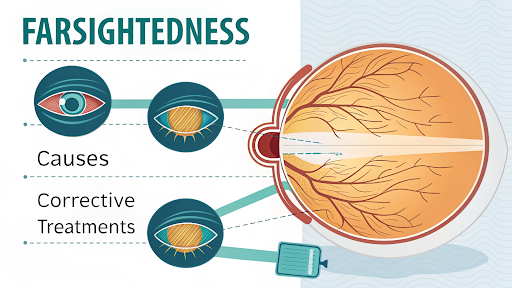
Farsightedness, also known as hyperopia, is a common vision condition in which distant objects are seen more clearly than those that are near. This condition is a type of refractive error where the eye focuses light behind the retina instead of directly on it. Farsightedness can affect people of all ages, including children and older adults. Understanding the causes of farsightedness, recognizing its symptoms, and exploring available corrective treatment for farsightedness is crucial for maintaining good eye health.
What Is Farsightedness (Hyperopia)?
Hyperopia occurs when the cornea curvature is too flat or the eyeball is shorter than normal, preventing light rays from properly focusing on the retina. This misalignment results in blurry vision , particularly for close-up tasks such as reading.
Causes of Farsightedness
There are several common causes of farsightedness:
- Genetics: A family history of refractive errors increases the risk.
- Eye shape abnormalities: The length of the eyeball or shape of the cornea can impact how the eye refracts light.
- Age-related farsightedness (Presbyopia): As we age, the lens becomes less flexible, making it harder to focus on nearby objects.
Farsightedness Symptoms
Individuals with farsightedness may experience:
- Eye strain or general eye discomfort
- Blurry near vision
- Headaches after reading or doing close work
- Lazy eye (amblyopia) in children if uncorrected
- Difficulty focusing or rapid fatigue during close tasks
These symptoms can vary depending on the severity of farsightedness. In some cases, especially among children, the condition may go unnoticed until a full eye exam is conducted.
Diagnosis of Hyperopia
A comprehensive eye examination by a qualified optometrist or ophthalmologist is essential to diagnose hyperopia. This includes:
- Visual acuity test
- Refraction test to determine the exact lens prescription
- Assessment of eye movement, alignment, and overall eye health
At a trusted eye hospital in Lucknow, you can expect complete eye evaluations that detect farsightedness, nearsightedness (myopia), astigmatism, and other common eye disorders.
Corrective Treatment for Farsightedness
Fortunately, farsightedness is highly treatable. Here are some vision correction options:
-
Eyeglasses for Hyperopia: Prescription eyeglasses with convex lenses help redirect
light onto the retina.
These are easy to use and suitable for mild farsightedness to severe hyperopia. -
Contact Lenses: Contact lenses are thin, curved corrective lenses that sit directly
on the eye.
They provide a wider field of vision and are suitable for active lifestyles. -
Laser Eye Surgery for Farsightedness: Procedures like LASIK
surgery and other
refractive surgery methods reshape the cornea for more-permanent correction.
Ideal for adults with stable vision prescriptions and no major eye diseases.
Note: These treatments may have temporary side effects, such as dry eyes or light sensitivity, but are usually minor.
Farsightedness in Children
Farsightedness in children is often harder to detect as kids may not report vision problems. Untreated hyperopia can lead to amblyopia (lazy eye) or other complications such as poor academic performance or behavioral issues due to uncorrected visual symptoms.
Regular eye exams from an early age are essential. If diagnosed, prescription lenses or protective eyewear can help correct the issue and support proper eye development.
When to Visit an Eye Doctor
You should consult an eye doctor or visit a reputable eye hospital in Lucknow if you notice:
- Persistent blurry vision or eye strain
- Difficulty focusing on close-up tasks
- Vision loss or sudden changes in visual acuity
👁🗨 Lucknow’s #1 Trusted Eye Hospital 🏥✨
Delaying treatment can lead to further complications, such as vision loss, lazy eye, or retinopathy in rare cases.
Farsightedness is a manageable refractive error that affects people of all ages. Whether due to genetics or age-related changes, you can easily correct this condition with eyeglasses or contact lenses. In more severe cases, laser eye surgery offers a long-term solution.
If you're experiencing eye trouble, schedule a complete eye test at an eye care provider near you. For expert diagnosis and treatment, trust a leading eye hospital in Lucknow that offers specialized care from qualified eye doctors and ophthalmologists.
Prioritize your eye care today to avoid vision problems tomorrow!